Ternate vs Raja Ampat: Which Is Best for Luxury Diving?
Updated: July 2026
Ternate vs Raja Ampat: Which Is Best for Luxury Diving?
- Unrivaled Exclusivity: Dive pristine sites with only your private group, a stark contrast to the 100+ liveaboards operating in Raja Ampat.
- Unique Volcanic Diving: Experience a rare combination of vibrant coral walls, WWII wrecks, and world-class black sand muck diving.
- Rich Cultural Depth: Your underwater exploration is framed by a surface world of 16th-century forts, active volcanoes, and living spice trade history.
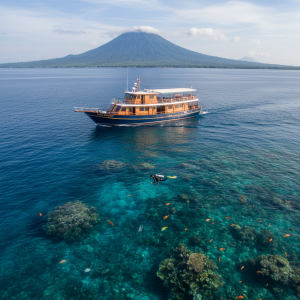
The air, thick and sweet with the scent of drying cloves, hangs over the water. Below our boat, the sea shifts from cobalt to a deep, mysterious indigo, hinting at the volcanic slopes that plunge into the abyss. We are anchored off the coast of Hiri, a satellite island in the shadow of Ternate’s perfect volcanic cone, and we are completely alone. This is the central question for today’s luxury adventurer: Does one follow the well-documented path to Raja Ampat, the celebrated “Amazon of the Seas,” or pivot to a destination that offers not just spectacular marine life, but a palpable sense of discovery? The debate of Ternate vs Raja Ampat is not about which is better, but which is right for the modern explorer who values privacy as much as pelagics.
The Diving Scene: Crowds vs. Cherished Exclusivity
There is no denying Raja Ampat’s underwater credentials. With over 1,600 species of reef fish and 75% of the world’s known coral species, its reputation as a global epicenter of marine biodiversity is well-earned. As confirmed by conservation groups and government bodies like indonesia.travel, it is a biological phenomenon. This fame, however, comes at a price. During the peak season from October to April, it’s not uncommon for marquee dive sites like Cape Kri or Manta Sandy to host three, four, or even five liveaboards at once. You may be on a $10,000-a-week private phinisi, but you will likely be sharing the reef. For many, this is a perfectly acceptable trade-off. For the traveler I write for, the one who seeks genuine solitude, it can dilute the magic.
Ternate, by contrast, remains gloriously, intentionally, under the radar. The entire North Maluku province has fewer than a dozen reputable dive operators, compared to the hundred-plus vessels registered to cruise Raja Ampat. Here, the concept of a “crowded” dive site is nonexistent. On a recent trip, my guide, a local Ternatean named Yusuf, explained, “We don’t have to schedule our dives to avoid other boats. We schedule them for the perfect tide.” Over a week of diving the waters around Ternate, Tidore, and Hiri, we encountered exactly one other dive boat. This solitude transforms the experience. It fosters a profound connection to the environment, a feeling that you are not just a visitor, but a privileged, solitary witness to its wonders. This is the new luxury: not just seeing something amazing, but having it all to yourself.
Marine Topography: Epic Vistas vs. Volcanic Mysteries
The underwater architecture of these two destinations is a direct reflection of their geology. Raja Ampat is defined by its sprawling karst limestone topography. This creates the iconic scenery of mushroom-shaped islands and a submerged world of dramatic swim-throughs, vast plateaus, and deep channels where currents bring in the big pelagics. It is, without question, a wide-angle photographer’s dream. The sheer scale is immense; the archipelago covers 4.6 million hectares, offering seemingly endless coral gardens that stretch as far as the eye can see. Sites in Misool, with their vibrant soft corals, are visual masterpieces. It is an environment of sweeping, grand-scale beauty, a powerful display of nature’s reef-building prowess over millennia.
Ternate offers a more intimate and texturally diverse narrative. Its underwater world is a direct consequence of the active volcano, Mount Gamalama, that dominates the island. Here, you find dramatic, near-vertical walls formed by ancient lava flows, now completely encrusted in healthy hard and soft corals. But the true secret of Ternate diving lies in its duality. In the bays and coves, you find extensive black sand slopes—a macro photographer’s paradise. This is world-class muck diving, where the volcanic substrate hosts a collection of rare critters: hairy frogfish, blue-ringed octopus, flamboyant cuttlefish, and a dozen species of nudibranch on a single dive. One moment you’re marveling at a pygmy seahorse, the next you’re exploring the wreck of a Japanese cargo ship from 1944. This combination of pristine walls, historical wrecks, and critter-rich volcanic sand is something Raja Ampat simply cannot offer. It is a more complex, multi-layered diving environment.
The Luxury Experience Above the Water
In Raja Ampat, the luxury experience is overwhelmingly water-based. The pinnacle of a trip is securing a cabin on a high-end phinisi, a traditional Indonesian two-masted sailing ship refitted with modern amenities. These vessels are magnificent, offering superb service, private chefs, and dedicated dive guides. They are floating boutique hotels that grant access to the most remote corners of the archipelago. On land, options are limited to a few exclusive eco-resorts, often on their own private islands, which require a significant additional transfer by speedboat from the port of Sorong. The focus is on splendid isolation, a detachment from the world. This is ideal for those who want to disconnect completely, with the rhythm of their days dictated solely by the tides and the dive plan. The investment is considerable, with top-tier private charters easily exceeding $70,000 per week.
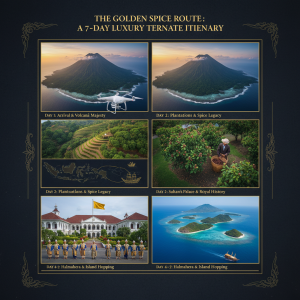
The luxury proposition on Ternate Island is fundamentally different; it is land-based and deeply integrated with the island’s culture and history. The experience extends far beyond the dive boat. After a morning exploring underwater lava tubes, your afternoon can be spent walking the ramparts of the 16th-century Fort Tolukko, a Portuguese bastion against the Spanish. You can meet the Sultan at his palace, or visit a centuries-old clove plantation where the air is heavy with spice. Accommodations are in exclusive-use villas and boutique colonial-style hotels that offer a sense of place and history. This is a destination for the intellectually curious traveler, the person who wants their adventure to have a narrative. It’s for the diver who is also a historian, a foodie, and a cultural explorer. The luxury here is not just in the thread count of the sheets, but in the richness of the experience and the depth of the story you get to be a part of.
Accessibility and Logistics: The Journey’s Demands
Reaching a remote paradise is part of its allure, but the logistical demands can be a deciding factor for the time-conscious traveler. Getting to Raja Ampat is an expedition in itself. The typical route from North America or Europe involves a flight to a major Asian hub, a connecting flight to Jakarta (CGK) or Makassar (UPG), another flight to Sorong (SOQ) in West Papua, and finally, a multi-hour ferry or private speedboat transfer to your liveaboard or island resort. Realistically, you must budget nearly two full days of travel on each end of your trip. While the destination is worth the effort, the journey can be draining and eats into valuable vacation time. This significant time and energy investment is a barrier for many who can only spare a week or ten days.
Ternate, while feeling worlds away, is logistically far more straightforward. Its Sultan Babullah Airport (TTE) is well-serviced with multiple daily flights from major Indonesian hubs like Jakarta and Makassar. You can leave a hotel in central Jakarta in the morning and be checked into your villa in Ternate by mid-afternoon. From the airport, it is a mere 15-to-20-minute drive to the primary resorts and dive centers. This ease of access is a game-changer. It means less time in transit and more time enjoying the destination. You can comfortably plan a 7-night trip and feel you’ve had a full, immersive experience without the exhaustion of a multi-day journey. For a luxury traveler, time is the ultimate currency, and Ternate’s accessibility offers a far better return on that investment.
A Question of Heritage: Natural Wonder vs. Living History
Every great destination has a story. Raja Ampat’s story is one of natural history on an epic scale. Its inclusion on UNESCO’s Tentative World Heritage List is its global significance as a cradle of marine life. It is a living laboratory of evolution, a place that feels primordial and untouched by human hands (though it has a rich local culture). The heritage here is ecological, a celebration of the planet’s creative power. The narrative is written in coral DNA and the migratory patterns of manta rays. It is a powerful and important story, but it is one told primarily by nature itself.
Ternate’s story is a dramatic human saga, written in blood, ambition, and spice. For centuries, this tiny volcanic island, along with its neighbor Tidore, was the sole source of cloves on the entire planet. This monopoly made its sultans fantastically wealthy and placed it at the absolute center of global geopolitics. As detailed in the history of the Spice Trade, nations went to war over these islands. The Portuguese, Spanish, Dutch, and English all fought and schemed to control this prize. Diving in Ternate is to swim through living history. The very waters you explore were once filled with European galleons and local war canoes. The reefs grow on the same volcanic slopes that Magellan’s surviving crew would have seen in 1521. This historical resonance adds an entirely different dimension to the journey. You are not just exploring a reef; you are exploring the epicenter of the Age of Discovery.
Quick FAQ: Your Ternate vs. Raja Ampat Questions Answered
Which is better for underwater photographers? For wide-angle photographers aiming to capture immense coral vistas and massive schools of fish, Raja Ampat is the premier choice. For macro enthusiasts, however, Ternate is a world-class contender. Its black volcanic sand provides a dramatic backdrop for the weird and wonderful critters that define muck diving, offering opportunities to photograph rare species.
What about non-diving partners or “surface interval” activities? While Raja Ampat offers beautiful kayaking, paddleboarding, and village visits, the options are limited by the remote, water-based nature of the trip. Ternate provides a far richer and more diverse range of surface activities, from hiking the 1,715-meter Mount Gamalama volcano and exploring historical forts to visiting bustling local markets and touring active spice plantations. It is a more complete cultural destination.
What is the best time of year to visit each destination? Raja Ampat’s prime diving season runs from October through April, during the dry northwest monsoon, when seas are calmest. Ternate’s diving is excellent year-round, but the best conditions—calm seas and optimal visibility often exceeding 30 meters—are typically found between March and November, offering a broader and more flexible travel window.
Is one significantly more expensive than the other? On a per-day basis for a top-tier experience, Raja Ampat is generally more expensive due to the high operational costs of luxury liveaboards. A 10-day trip can easily cost over $8,000 per person, before flights. Ternate offers a more favorable value proposition, with luxury land-based accommodations and private diving services available at a more accessible price point, without compromising on quality or exclusivity.
The choice between these two Indonesian jewels ultimately comes down to your definition of adventure. Raja Ampat is an astonishing spectacle of nature, a place to witness the sheer abundance of marine life on a scale found nowhere else. It is a journey for the naturalist. Ternate, however, is a destination for the connoisseur. It is for the traveler who understands that true luxury is not just about what you see, but about how you see it—and the story that unfolds around you. It offers a rare trifecta: world-class diving, absolute exclusivity, and a profound connection to a history that shaped the modern world. For the traveler who seeks not just to see the ocean, but to understand its place in our shared human story, the choice becomes clear. Explore the depths of history and the sea with us. Discover the allure of a Ternate Island: Your Luxury Escape to the Historic Spice Islands expedition.